A primer for the physicist who suspects something is missing from current frameworks — and can do the math I desperately need help with.
Five Constructs. One Generative Sequence.
QSpace operates in four spatial dimensions. Three dimensions cannot close a Möbius topology that produces stable recursive structures — the fourth dimension is the geometric minimum the framework requires. Once that is accepted, several things that look mysterious stop being mysterious. Entanglement, for instance: two structures sharing a 4D connection were never actually separated. The W-axis was always there.
All constructs are in motion, always. This is referred to as flow — flow in/out, flow along the face, or spiral/recursive/resonant flow. Flow refers to the action of the Q construct constantly expressing, falling or flowing along each degree of freedom.
QSpace is built from five geometric constructs. They don’t coexist as equals — they generate each other in sequence, each one the previous construct having folded through itself in 4D.
Q — the base 4D construct. A 4D structure with no preferred direction and no committed flow. Not a particle, not a force, not a wave (yet). Geometry that has not yet been restricted. Its precise mathematical characterization is one of the open formalization problems — what it is geometrically is clear; what it maps to in existing formalisms is part of what a collaborator would help establish.
Qt — Q folded through itself once in 4D. The fold locks one degree of freedom — time direction. Something that was isotropic now has a forward. Time is now a direction, not omni-directional — it can vary, but it flows one way.
QP (Quanta Push) — Qt folded through itself again. The second fold locks spatial direction. Six degrees of freedom remain open. This is the flowing 4D sheet. The two fold points are locked inside the geometry in the W axis — invisible to 3D, holding the structure together. What remains exposed are four ports: H1 and H2 on the Head side, T1 and T2 on the Tail side. Those ports aren’t features added to the sheet — they’re the open geometry left after two self-folds. Everything inside the sheet is locked fold. Everything at the edges is open DOF. All propagation — light, electricity, field transmission of any kind — is QP.
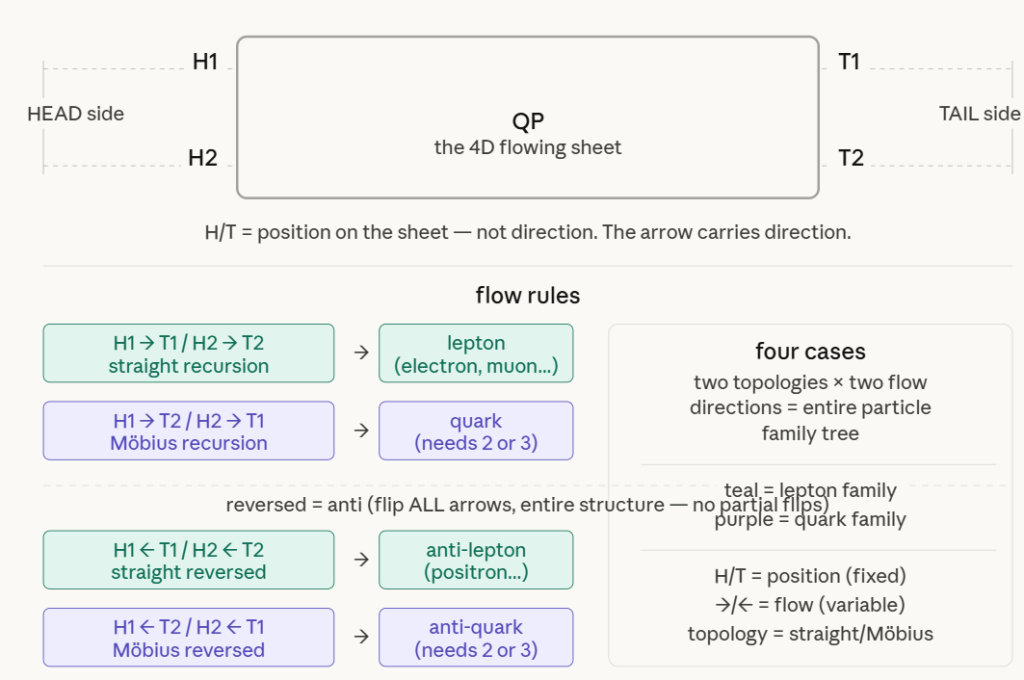
QCs (Quanta Curvature, straight) — QP that has closed back on itself recursively through a straight topology. Solid, singular, uniform. This is the lepton family. The electron is QCs.
QCm (Quanta Curvature, Möbius) — QP that has closed back on itself through a Möbius topology. The half-twist changes everything. The Möbius geometry requires partner structures before it can close stably — it cannot stand alone. The triplet requirement for quarks is not a rule that was added. It is a geometric consequence of Möbius port topology.
The quark family is different again: two QPs continuously trading roles — one flowing, one curving, swapping at each end of a Möbius twist. A single Möbius structure can’t close its own edge geometry. It requires two (meson) or three (baryon) to reach stability. Confinement isn’t a rule imposed on quarks. It’s the geometry refusing to close with fewer.
For the Möbius family there’s one absolute rule: flip the entire structure or it blows apart. No partial flips. Antimatter baryons exist and are stable because the entire triplet flipped — geometry closes cleanly. Baryon asymmetry doesn’t need a separate CP violation parameter. Partial flips are lethal. Complete flips are geometrically rare. The universe is matter-dominated because the geometry made it so.
QP Sheet Geometry
QP (Quanta Push) is a flowing 4D sheet. All flow is QP — light, electricity, propagation of any kind. All persistent curvature is QC — mass, gravity, stable particles. QP has two modes: resonance, where it propagates forward as light and EM usually aligned with another QP, and recursion, where QP pins to itself around another QP and becomes QC. Same construct, two commitments. QC isn’t a separate thing — it’s QP that was forced into recursion, losing one W-plane degree of freedom at the pin point. The QP that forces the recursion is the PIN in the recursion. The rotation that results is what mass is.
As noted QP looks like a sheet — flat, directional, with a slight presence in the W dimension that doesn’t behave like normal 3D depth. That’s not a visualization artifact. The sheet is a 4D structure that has folded through itself twice. The fold points are locked inside the geometry, invisible to 3D, living entirely in the W axis. What expresses into 3D is the open face of the structure after those folds. The slight W depth you can detect is the fold itself — real, active, holding the structure together, but not extending in X, Y, or Z. The sheet has depth in the only direction it can have depth.
The five constructs aren’t five different things. They’re the same geometry, progressively self-folding. Each construct is the previous one having folded through itself in 4D — locking one more degree of freedom into the interior with each fold. Flow isn’t something the geometry does on top of that — flow is what open degrees of freedom look like from 3D. The more DOF locked inward by self-folding, the more concentrated the expression through whatever open geometry remains. A fully recursive structure (QCs, QCm) has closed all remaining DOF inward — the expression is entirely self-contained. That’s stability. That’s mass. That’s also why destroying a particle releases energy: the DOF that were locked inward are suddenly free, and they express outward all at once.
What Flow Actually Is
Flow is not a property the geometry has. It’s what open degrees of freedom look like from 3D.
Q has no locked DOF — no preferred direction, no committed expression. It doesn’t flow anywhere because all directions are equally available. Each self-fold through the sequence closes off one more DOF into the interior. The geometry doesn’t gain energy at each step — the total is constant. What changes is how many DOF are available to express it outward. The fewer open DOF remain, the more concentrated the expression through those that do. That concentration is what we observe as flow, propagation, and the flee behavior visible at every scale in QSpace.
The sheet’s slight W depth now has a clean explanation. The fold points from Qt’s two self-folds are locked in the W axis. They’re not extending in X, Y, or Z — they have no 3D depth. But they’re real, active geometry holding the structure together, and they partially express into the 3D window as that anomalous presence. The sheet looks flat because the fold is in W. It feels like it has depth because the fold is real.
The ports — H1, H2, T1, T2 — are where they are for the same reason. They’re not arbitrary attachment points. They’re the open geometry that didn’t participate in either self-fold. The interior of the sheet is entirely locked fold. The edges are entirely open DOF. Flee behavior is strongest at the ports not because ports are special, but because they’re the only place the locked interior geometry has left to express through.
The constraint sequence runs in both directions:
- Inward (Q → QCs/m): Self-folds progressively close DOF into the interior. Expression becomes more directional through fewer open channels, until recursion closes the last DOF inward. Stable particle. Energy facing in.
- Outward (QCs/m → QP): Force the recursion open — nuclear reaction, annihilation, collision beyond the Curvature Failure Limit — and the DOF that were locked inward are suddenly free. They express outward all at once. That’s not energy being created. That’s stored geometric constraint releasing. The energy was always there, facing in. Now it’s facing out.
Matter is stored recursion. Energy release is the geometry returning toward open DOF expression. The nuclear reaction isn’t adding energy — it’s unlocking it.
How Do Construct Transitions Occur?
The construct must align and resonate — meaning flow is now across and fixed. What was multi-directional must flow one direction to resonate. The transition requires any circumstance where ports align geometrically and can resonate or recurse without repelling. Example: H1 > T1 and H2 > T2 (Head 1,2 resonating and flowing into Tail 1,2).
What “Expressing” Means
QSpace is a 4D framework. We live in 4D but can only directly perceive 3D. The 4D geometry doesn’t project into 3D the way a shadow projects from an object. It expresses into 3D — the way a 3D object expresses a 2D cross-section when you slice it. The cross-section is real. It carries information about the full structure. But it is not the full structure.
Some 4D structures have faces that only partially intersect our 3D window depending on orientation in the W-axis. As the geometry rotates, different faces present. What we measure is the face that is presenting at the moment of interaction — not the full structure. This is why quantum measurements produce probability distributions: not because the universe is random, but because we are sampling a 4D structure from a fixed 3D vantage. The probability distribution is the rotation geometry, nothing more.
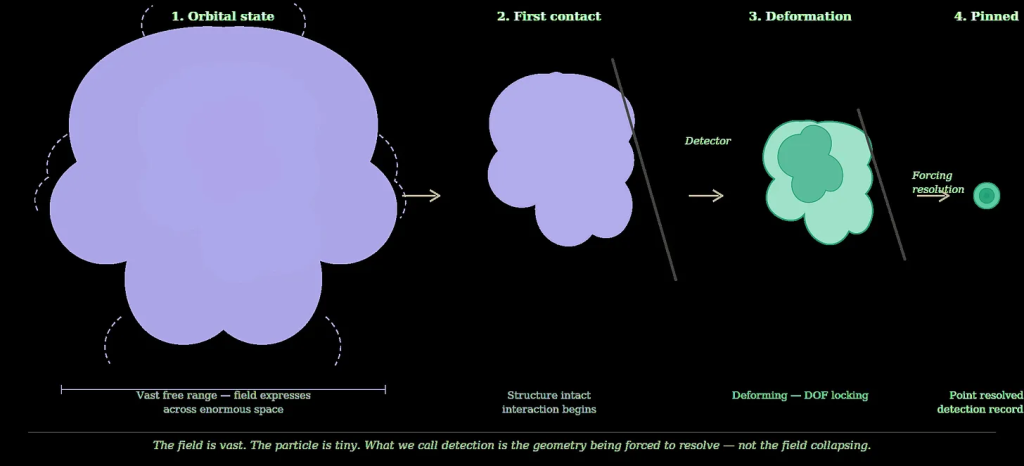
“The field is ~100,000× larger than the point it resolves to. Detection doesn’t find the particle — it forces the 4D geometry to commit to a 3D address. The field was never the particle. The particle is what the geometry looks like when you make it stop expressing freely. The electron is what remains when the 4D field gets pinned to a 3D point.”
What the constructs look or act like from our side:
- QP in free propagation: light, heat, and EM fields.
- QP pinned into QCs: a stable charged particle with spin-½. “H12>T12 straight recursion”
- QP pinned into QCm: a quark — confined, fractional charge, requires partners. “H12>T21 Möbius recursion”
- QC Size of the structure: mass.
- QC Alignment of the structure: particle stability.
- QC Recursion rate: time.
- QC Recursion depth gradient across a region: gravity — partly expressed Q structure field from 4D (the only parts able to interact with 3D QP, QCs, QCm structures).
None of these are defined by hand. They fall out.
Port Geometry: The Coupling Rule
Three things are forbidden by the geometry:
- Head-to-Head or Tail-to-Tail port contact. Geometric incompatibility at the connection itself. They repel.
- Head-to-Head or Tail-to-Tail face opposition. Weaker than port-level, but real — this is what prevents structures from collapsing into each other under normal conditions. It is what keeps the electron and proton separated in hydrogen: the faces are alike and repel, even though the ports connect cleanly.
- Forced curvature overlap. Pushing two recursive constructs (QC into QC) — forcing them into each other’s recursion space (surface flow) — triggers repulsion at Casimir scales, violent enough to disrupt core flow geometry directly. This is not a soft boundary.
Everything else is permitted. Head connects to Tail. Chains form freely. But true recursion is self-closure — one structure folding back through its own geometry. As chains grow, the probability of a forbidden condition somewhere in the assembly increases. When a QC reaches the Curvature Failure Limit (the point where enough variance causes recursion failure), the response is recursion failure and return to QP. Large structures are not forbidden — they are just hard to hold together, and the geometry is ruthless about imprecision.
Port geometry produces the interaction forces:
- Opposite port types meeting (H to T): electromagnetic attraction.
- Same port types meeting (H to H or T to T): electromagnetic repulsion.
- Möbius port lock: the strong force. Confinement is geometric — QCm topology cannot present a stable open external port in isolation.
- Recursive curvature depth gradient in the surrounding field: gravity — very much like the electron cloud before it’s poked and collapses.
The electron and proton don’t orbit because of a rule. Their ports lock — opposite ports attract — but their faces repel. The orbital is the equilibrium between those two geometric forces. The electron can’t spiral in because face repulsion prevents full seating regardless of port lock strength. Both structures spin forever — stopping would mean ceasing to exist. Two forever-spinning coupled structures at a stable orbital distance naturally synchronize. The hydrogen atom spins cleanly not because angular momentum is conserved by fiat, but because it’s the least bad configuration available.
This scales without new rules. Two hydrogen atoms approach: port geometry finds a less bad configuration together than apart — that’s a covalent bond. Push harder and proton faces interact — neutron geometry mediates between otherwise repelling faces, no separate strong force needed. Push harder still and you’re forcing Möbius structures into configurations so far from least-bad that they blow apart. The particle zoo isn’t a list of fundamental things. It’s a catalog of the most common ways the geometry fails to close at specific energy levels.
Nothing is forced. Everything finds the least bad state.
Three Things the Geometry Produced Without Being Asked
1. Spin-½
The Pin Model: pinning or resonance between two constructs — free 4D structures — obligatorily produces rotation in the remainder. You don’t add spin. You can’t suppress it. Pinning and rotation are the same event, and it is a binary outcome. The ½ factor comes from the 4D rotation geometry — a 4D structure requires a 720° rotation to return to its original state, which expresses in 3D as the spin-½ property physicists measure.
QSpace didn’t explain spin-½. It derived it as a geometric necessity of the pin event.
2. Matter/Antimatter Asymmetry
QC flowing H12 → T12 is QCs. QC flowing H12 ← T12 (reversed flow) is anti-QC (antimatter). Anti-QC geometry arises from the reverse flow. The asymmetry isn’t a parameter — it’s a flow going the other way, which is completely acceptable in QSpace. It’s a consequence of which chirality the first pin event selects: a binary outcome. One chirality produces matter geometry. The other produces antimatter geometry. They cannot coexist easily in bonded structures, because like ports repel. In most cases, QCs and anti-QCs meeting is an annihilation event.
The exact derivation of QCs and anti-QCs is pending. The formal proof is an open item. The prediction it generates — that the asymmetry is not a free parameter but a consequence of initial chirality selection — is falsifiable.
The asymmetry between matter and antimatter in the observable universe is a geometric prediction, not a fine-tuned parameter.
Note: the logic is considerably more complicated for QCm and anti-QCm.
3. The Electron Cloud
The electron isn’t smeared through space. It’s a QCs structure maintaining port resonance with the nucleus from 4D geometry. The cloud is the probability distribution of where the 4D structure expresses into 3D — which changes continuously as the geometry rotates. When a detector interacts with the electron, it forces a geometric contact that pins the 4D structure to a 3D location. The cloud collapses because the geometry changed, not because someone looked.
The same geometry also explains:
Nuclear magic numbers — quark confinement — entanglement — superposition — particle-wave duality — galaxy chirality bias — BAO shell spacing — why fertilization produces a flash of light — Hubble tension — the fine structure constant — why the neutron is stable inside a nucleus but not outside — why SU(3) has exactly 8 generators — why time runs slower near mass — why SO(4) describes particles as 4D — why measuring the double slit destroys the pattern — why structures band and shell at every scale, from electron orbitals to galactic redshift — early galaxy formation — gravitational lensing without visible mass — dark matter and dark energy as geometry rather than substances — and why the cosmological constant 10^120 problem is not a problem in QSpace.
The Retrodiction Record
70+ retrodictions across particle physics, nuclear structure, cosmology, condensed matter, and quantum mechanics. Same five constructs. Same port rules. Same coupling geometry. Zero failures to date — and I have tried numerous times.
The only failures were using 3D preconceptions. When I stick to the geometry, it works — even when it’s uncomfortable.
The strongest argument that this isn’t curve-fitting: the geometry keeps producing correct answers to questions that weren’t being asked. The neutron geometry fell out while deriving nuclear bonding. The three lepton generations fell out of the recursion depth constraint. The BAO shell spacing fell out of the QP-QC ignition threshold. None of these were targets.
When the same geometric key keeps opening different doors, that’s either a real structure or an extraordinary run of luck across 70+ independent results.
What Is Still Missing
The geometry is consistent and keeps matching observation. The formal mathematics is not complete.
Specifically:
- The coupling constants in the Lagrangian need derivation, not fitting. QSpace predicts they are geometric — but the derivation path requires formal 4D differential geometry that hasn’t been written yet.
- The port interaction rules need expression as a symmetry group. The structure suggests SU(N)−1 but N is an open question.
- The 6QFD (six quantum flow determinants: Φ, A, ℛ, χ, τ, κό) are the expressible coordinates of the 4D geometry. Their coupling structure needs formal treatment.
- Several derivations are geometric arguments that need proof — not because the geometry is wrong, but because ‘the geometry requires it’ is not yet ‘here is the proof.’
This is not evasion. The geometry is producing correct results faster than the formal mathematics can follow it. That’s the collaborator problem.
The geometry keeps producing the right answers. The math needs a collaborator.