This is the step-by-step for the flow from a free QP sheet to a QCs — a straight recursive loop with no twist. When I looked it up, the mathematical name for this topology is S³ (3-sphere).
Step A — QP₁: Free Tensor Flow QP1 moves freely as a 4D sheet. Its port geometry is fully exposed: H1 and H2 at the head end, T1 and T2 at the tail. All three faces — xw, yw, and zw — are open and active. Its not curved … yet. Pure forward flow (Φ): momentum without recursion.
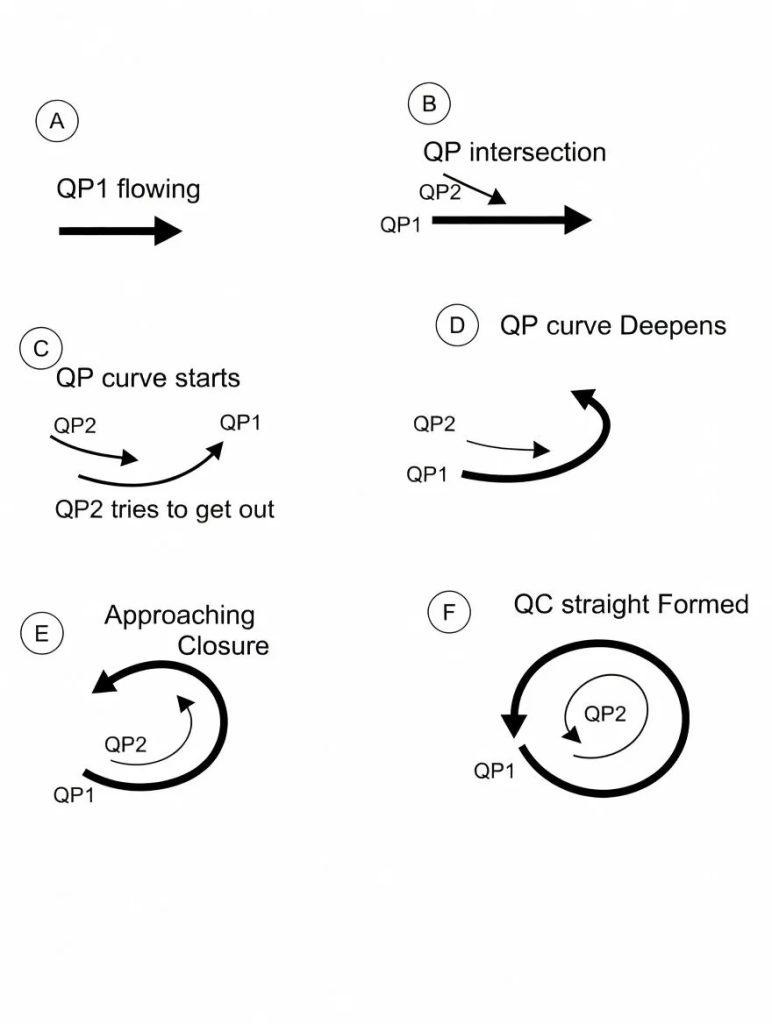
Step B — QP Intersection QP2 flies toward QP1. If its T(port)-to-H(face) or H(port)-to-T(face), the geometry would resonate and bond and end up being H1 >T1 or T2 or vice versa for the pair. That’s not what happens here. Instead the contact is T(port)-to-T(face) or H(port)-to-H(face). that is a repel or repulsion between T and T or H and H. QP2 is immediately flees or bounces (repels). But the contact has already initiated a curve in the face on QP1 and QP2 is geometrically behind that curve. The flee has begun, but so has the trap.
Step C — Curve Starts: QP₂ Flees Into Its Own Trap QP2 pushes forward but that is into the curve of QP1. That pressure causes more curve in QP1. QP2 cannot outrun what it initiated but it tries. QP2s port pressure against QP1’s face drives QP₁ to curve further. The harder QP2 pushes to escape, the more it accelerates QP1s curvature. QP2 is being curved/carried inside the developing arc, separated from QP1 by the repulsion gap (sort of like magnets repelling) — the same face pressure that is driving the curve is also preventing contact.
Step D — Curve Deepens: Face Pressure Locks the Arc QP1 is now the dominant outer structure. QP2 continues pressing outward via QP2port-to-QP1face repulsion, which continues deepening QP1’s curve. Both port flows — H1/H2 and T1/T2 on both sheets — are being carried around the same center of curvature. QP1 is approaching the condition where it begins to see its own tail. Recursion is initializing (and H flows to T or vice versa) so they chase each other.
Step E — Approaching Closure: A Face Gets Pinned QP1 is nearly a full circle. As QP1’s head approaches its own tail, one face — xw, yw, or zw — gets physically pinned between QP1 and QP2. The repel/repulse gap that kept them apart is now the mechanism that locks that face between them. The face is the same one that started where QP2 pushed into the middle of QP1 and the faces matched, ie same T-face-to-T-face or H-face-to-H-face. That pinned face is the confinement seal — it cannot be released without breaking the structure.
Step F — QC Straight Formed: One Face Lost, QP2 locked up or “buried” Closure completes. QP1 locks as the outer ring: H1→T1 and H2→T2 (or vice versa) The parallel port connection that defines QC-Straight, this is what QSpace says the lepton core geometry (plus 1 or 2 riders) is. I just NAME the pinned face as ZW — not because i know which pre-closure axis it was (that information does not survive into the resulting 3D geometry), but because we can describe what it does: it is consumed maintaining the interface between QP1 and the trapped QP2 inside… indefinitely (until QP1 reaches a curvature failure point).
What remains? Two free faces (I call them xXW + yYW) functioning as the sheet, and one linear flow direction (z) and the lost face expressed is called ZW.
QP2 is not gone. It is the reason QP1 can remain in one place/stable and create enough geometry to interact with other 4d structure expressed in 3d. QP2 is inside the closed QP1 loop — a QP flow under continuous face confinement. The QCs is stable as long as the QP1 face holds the interface. Use the face logic one is lost locking the QP2 in so you end up with zZW only expressing as z in 3d (zw is facing IN).
If QP1 breaks open, QP2’s compressed flow releases suddenly and flees the nearest QP (repels). That extra release is the energy of the decay event (the structure holding it is energy PLUS the tapped QP2. The decay products are not hiding inside the QCs — they are what the released geometry becomes when it is free to reorganize.
One interesting oddity of a FORMED QCs. Once formed QP may ride the curvature (ie repel along the surface or CHASE along the surface). That results in a curved QP that can accelerate further QC formation. In certain cases QC begets QC.
Leave a Reply